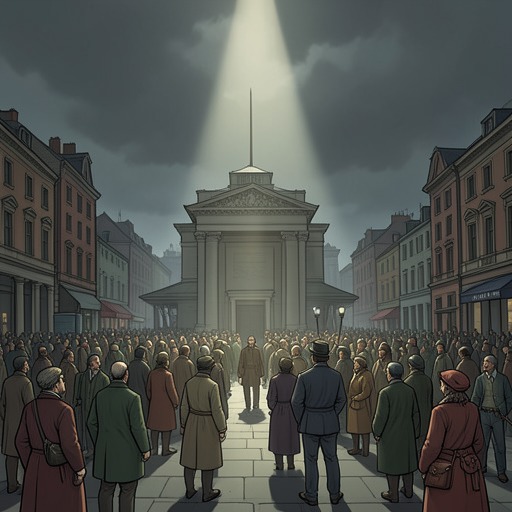
Obstruction
I ChingObstruction, also called Difficulty or Kien, is Hexagram 39, an essay on how to act when progress itself intensifies difficulty. Its governing lesson is not simply to press forward or retreat, but to judge the terrain, seek capable leadership, and remain firm and correct. The hexagram makes obstruction both a practical condition and a political test: sound action depends on knowing when movement serves the task and when it deepens the trouble.
Definition and Central Counsel
The hexagram’s judgment says that advantage lies in the southwest and disadvantage in the northeast; it is also advantageous to meet the great man, and good fortune follows from firmness and correctness. The directional contrast is explained through the trigrams in King Wen’s arrangement: the southwest is associated with Khwăn, the open plain, which is easier to traverse and hold, while the northeast is associated with Kăn, the mountainous region, where passage is difficult. On this reading, the directions become a practical instruction to calculate circumstances—taking advantage of conditions that favor an undertaking and avoiding those that threaten failure.
The commentary also records another possible historical reading. The southwest may refer to the southern and western regions especially devoted to King Wen and his house, in contrast with the north and east, where Shang power lay. The interpretation is presented as a possibility rather than an established fact. Whichever reading is followed, the counsel joins favorable circumstances to ethical discipline: advantageous ground and powerful assistance do not make firm correctness dispensable.
The Political Meaning of Difficulty
The commentary derives the hexagram’s central image from the character Kien, associated with incompetency in the feet and legs and the resulting difficulty of walking. That bodily impediment becomes a figure for a kingdom whose government is arduous. The image does not prescribe uninterrupted action: governing the crisis may require activity from the ruler at one moment and discreet inaction at another. The question is how to meet difficulty successfully, not how to deny that it exists.
This political emphasis belongs to a broader account of the Yî as a work composed in a world of disorder. Its sixty-four essays address moral, social, and political themes through symbolic language, and the hexagrams and their line texts offer indications about action and its auspicious or inauspicious consequences. The commentary situates King Wen’s study of the figures against the collapse of Shang rule, described as a condition of lawlessness, violence, treachery, and failing government. In that setting, a teaching about blocked progress carries more than private advice: it concerns the hard task of governing a disordered state.
Circumstance, Leadership, and Correctness
The commentary reads the judgment as requiring three things: attention to place, the presence of the great man, and the firm observance of correctness. Attention to place means assessing what circumstances make an undertaking feasible and what conditions threaten it. The great man is connected to the strong fifth line and its relation to the weak second line; the commentary identifies this figure with the kind of authoritative, capable minister associated with Mencius’s idea of the minister of Heaven.
Yet neither favorable conditions nor the presence of such a leader is enough by itself. The closing emphasis is that firm correctness remains necessary throughout the essays of the Yî. Obstruction thus resists a purely tactical reading: judgment about terrain and leadership must be joined to a standard of conduct that remains in force even when circumstances are difficult.
The Lines and the Discipline of Restraint
The line texts make the distinction between advance and restraint concrete. At the first line, advancing leads to greater difficulties, whereas staying in place affords grounds for praise. The second line depicts the king’s minister struggling through difficulty after difficulty, but not for personal advantage. At the top line, going forward increases the difficulties again; remaining stationary instead brings great merit, good fortune, and advantage in meeting the great man. Across these positions, delay is not automatically failure: its value depends on whether movement would aggravate the obstruction and whether restraint serves the larger task.
The line-by-line counsel reflects the work’s method. King Wen’s interpretation addresses each hexagram as a whole, while the Duke of Zhou’s line texts begin at the bottom and use emblematic situations to distinguish the significance and fortune attached to each position. In Obstruction, that structure allows a single political problem to be considered at different points of action. Its recurring contrast—advance that compounds difficulty versus stillness that earns praise or merit—turns the difficulty of movement into a precise test of judgment.